What Is the Best Power Inverter for Home Use in 2026?
Choosing the best Power Inverter For Home use in 2026 is not just a matter of buying the model with the biggest wattage. A refrigerator may draw a brief surge when its compressor starts. A router, lights, and phone chargers add smaller, steady loads. Those details shape what an inverter can reliably power during an outage.
Renewable-energy engineer John Wiles, known for his work on photovoltaic systems and electrical safety, offers a useful principle, paraphrased here: “Choose the inverter around the loads, battery, and wiring—not the headline wattage.” That is a practical starting point, not a complete buying rule. Readers should also compare continuous and surge ratings, output waveform, battery compatibility, protection features, and installation requirements. Check manufacturer specifications carefully; similar-looking ratings can describe very different performance.
Small details matter. So does the battery. A powerful inverter connected to an undersized battery may shut down when a motor starts. A model with a clean sine-wave output can better suit sensitive electronics, but it still needs proper sizing. There is no perfect pick for every home. I would not treat any single product ranking as final without checking the actual loads and backup duration. That takes a little effort. This guide examines the features that matter, the trade-offs behind common inverter types, and the questions to ask before choosing a home backup system.
What a Home Power Inverter Does and How It Works
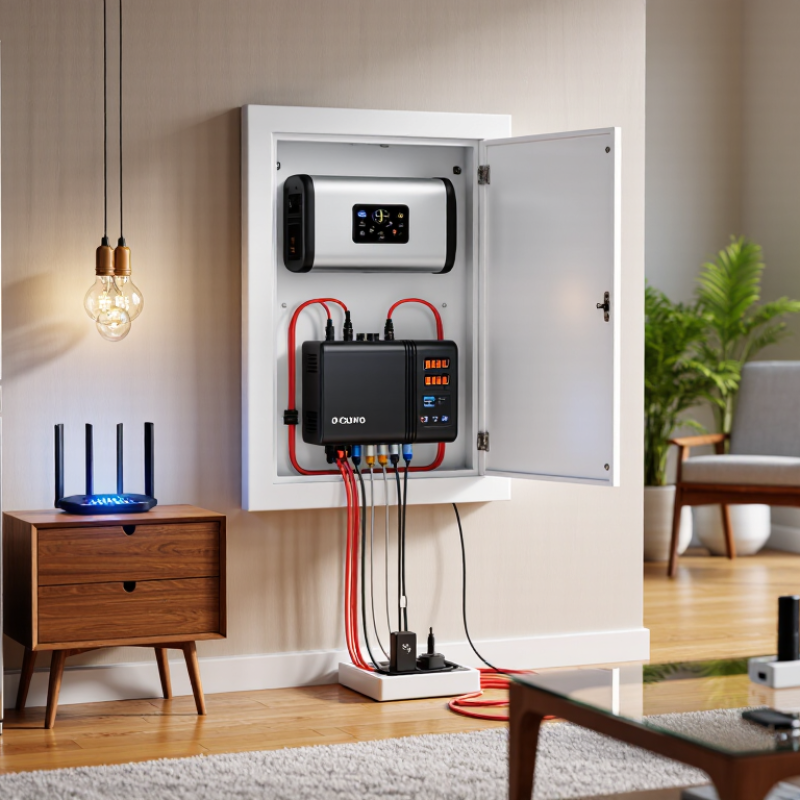
A home power inverter converts direct current from a battery or solar system into alternating current for household appliances. That is the electricity most wall outlets provide. NREL’s photovoltaic-system guidance describes this conversion as a core inverter function. Some models also manage battery charging or coordinate with solar equipment, but an inverter does not create stored energy.
No battery, no backup runtime.
Sizing starts with the appliances you need to run, not the largest number on a product label. Check continuous watts and brief startup surges; a refrigerator compressor may draw more power when it starts. Battery capacity, measured in kilowatt-hours, affects how long appliances run.
The U.S. Energy Information Administration reported average residential electricity use of about 899 kWh per month in 2022. That figure gives context, not a sizing target: household averages hide big differences.
That matters. A common planning mistake is focusing on peak wattage while overlooking runtime. Also check output waveform, ventilation, and whether fixed circuits need professionally installed transfer equipment to prevent dangerous backfeed.
These details are easy to miss. I would still treat any estimate as a starting point, since real loads and startup behavior vary.
How to Calculate the Inverter Capacity Your Household Needs
What Is the Best Power Inverter for Home Use in 2026?
To size an inverter, list the appliances you truly need during an outage. Check each device’s label or manual for its running watts. A refrigerator might use 150 watts while running, while its compressor briefly needs much more to start. Add the running watts of devices you expect to use together, then compare the result with the inverter’s continuous rating. It adds up. But not every appliance runs at once.
Next, check the largest startup surge. Motors in refrigerators, pumps, and some tools can briefly draw two or three times their normal power. The inverter’s surge rating must cover that moment, not just the average load. For example, a 150-watt refrigerator, 60 watts of lights, and a 90-watt laptop total 300 running watts. If the refrigerator needs 600 watts at startup, allow for that peak alongside other active loads. Real homes are messy; a kettle may get plugged in unexpectedly.
Capacity and runtime are different questions. Estimate battery energy by multiplying the load in watts by the hours needed, then dividing by inverter efficiency. A 400-watt load for four hours at 85 percent efficiency needs about 1,880 watt-hours. Add a practical reserve, since actual use and battery performance vary. I would recheck the appliance labels before buying; estimates from memory are often a little optimistic. For fixed household circuits, ask a qualified electrician to assess the installation.
How Much Inverter Capacity Does Your Home Need?
Example household loads in watts. Actual appliance requirements vary; check each appliance’s nameplate or manual.
Add the running watts of appliances you expect to use at the same time, then allow about 20–25% extra continuous capacity. In this example, the loads total about 2,125 W, suggesting an inverter rated around 2,700 W or higher. Motors such as pumps and refrigerators can briefly draw more power when starting, so also check the inverter’s surge rating. Avoid assuming every motor starts at once, and verify actual surge requirements with appliance specifications.
Types of Power Inverters and Their Home Applications
For home use in 2026, the best inverter depends on what you need to power and for how long. A modified sine wave inverter can run simple resistive loads, such as some lamps or basic heating devices. It is often less expensive, but motors may run hotter or make extra noise. Not ideal for everything.
A pure sine wave inverter produces power closer to household mains electricity. It is generally a better fit for refrigerators, medical equipment, audio systems, and modern electronics with sensitive power supplies. Check each device’s starting surge, not just its running wattage. A refrigerator may briefly demand much more power when its compressor starts. Small detail, big difference.
An inverter-charger combines battery charging with backup power, making it useful where outages are occasional. A grid-tied inverter works with a solar system and household wiring, but it is not automatically a backup source during a blackout; many systems shut down unless designed with backup capability. For off-grid cabins or essential circuits, an appropriately sized battery inverter can supply stored energy. Match its continuous and surge ratings to the actual loads, and have permanent wiring assessed by a qualified electrician. I would not size a system from a single appliance label alone; real usage can be messier.
Battery Compatibility, Installation, and Safety Considerations
A home inverter is only as dependable as its battery match. Check the battery’s nominal voltage, operating range, maximum charge and discharge current, and communication requirements against the inverter manual. A mismatch can trigger shutdowns or shorten battery life. Also compare continuous output with the loads you actually need: a refrigerator, modem, and a few lights differ greatly from an electric oven. The U.S. Energy Information Administration’s Electric Power Annual reports an average of about 5.5 hours of customer interruptions in 2022, including major events. That figure is a useful reminder to size backup around essential circuits, not the whole house. Measure real loads if you can.
Installation deserves equal care. Keep batteries in a dry, ventilated location within the manufacturer’s temperature limits, and leave clear access for inspection. A qualified electrician should verify conductor size, overcurrent protection, grounding, and transfer equipment. The U.S. Department of Energy’s Consumer Guide to Home Energy Storage advises using equipment evaluated for safety and having systems installed by qualified professionals; UL 9540 covers energy storage systems. Never improvise wiring or place a battery beside a heat source. Small details matter. I would still recheck the manual before commissioning; similar-looking models can have different limits. Check alarms and shutdown instructions, too, and make sure household members know how to isolate the system safely.
How to Compare Home Power Inverters in 2026
What Is the Best Power Inverter for Home Use in 2026?
How to Compare Home Power Inverters in 2026
The best choice depends on what you need to keep running during an outage. List each device, its running wattage, and any startup surge, such as a refrigerator compressor kicking on. Compare those figures with the inverter’s continuous and peak ratings; peak power is not meant for long-term use. That matters. A little headroom can help prevent overloads, but buying far more capacity than needed may add cost without practical benefit.
Tips: Check whether the inverter produces a pure sine wave if you plan to power sensitive electronics. Confirm battery voltage compatibility, connection requirements, cooling clearance, and audible fan noise. Read the manual for installation limits, and ask a qualified electrician about fixed wiring. Check the label. Local safety certification and installation requirements can differ.
Compare models by usable output, protection features, warranty terms, and clear documentation—not headline wattage alone. Look for overload, overheating, and low-voltage protection, and verify that the unit suits your battery system. A quiet inverter may still need open space around its vents. That detail is easy to miss. One trade-off is worth admitting: the most powerful option is not always the most useful one. Recheck your appliance list before deciding; estimates can be wrong.
What Is the Best Power Inverter for Home Use in 2026? - How to Compare Home Power Inverters in 2026
| Inverter class | Typical continuous output | Common battery voltage | Typical conversion efficiency | Good fit for | What to check before buying |
| Compact pure sine wave | 300–600 W | 12 V | About 85–92% | Routers, LED lights, small electronics, and charging devices | Confirm the continuous rating, low-voltage cutoff, and whether the battery can supply the required current. |
| Mid-range pure sine wave | 1,000–2,000 W | 12 V or 24 V | About 88–93% | Several household electronics, a television, or selected small appliances | Check surge capacity for motor-driven loads and allow for the high DC current drawn at full output. |
| High-output pure sine wave | 3,000–5,000 W | 24 V or 48 V | About 90–94% | Larger backup loads or multiple appliances, when paired with a suitable battery bank | Verify battery discharge limits, cable and fuse sizing, cooling, and whether professional installation is needed. |
| Hybrid inverter with charger | Commonly 3,000–6,000 W; model-dependent | Often 24 V or 48 V | Varies by operating mode and model | Backup systems that combine batteries with utility power and, on compatible models, solar input | Check solar input limits, charging compatibility, transfer-switch behavior, and local electrical requirements. |
Comparison note: Figures are indicative ranges for inverter categories, not guarantees for every unit. Efficiency, surge duration, and usable output vary by model and operating conditions. Choose a pure sine wave output for sensitive electronics and appliances whose manufacturers specify it. Size the inverter using the loads’ running watts and startup surge, and confirm that the battery, wiring, and protection devices can safely support the system.