
For over 50 years, we have dedicated ourselves to providing Industry with best in class wire management solutions and to helping solve mission critical issues.

The needs of today’s schools and universities are changing fast. When it comes to anticipating and meeting those needs, MonoSystems is in a class of its own.
For the past five decades, we’ve made it our business to offer more value to our partners, which in turn provides greater value to their customers.
Robot Teleoperation Data Collection turns skilled human actions into training examples for robots. The best providers do more than record joystick movements. They capture synchronized video, robot states, task outcomes, and operator actions. That context helps teams understand why a robot succeeded—or failed.
Robot-learning researcher Sergey Levine’s work offers a useful principle, stated here as a paraphrase: useful demonstrations matter more than raw data volume alone. Quality shows up in practical details. Can operators control the robot smoothly despite latency? Are camera views clear when a gripper approaches a small object? Do collected tasks include recovery after a dropped item? These details shape whether data transfers to real work. Small failures count.
This guide compares seven providers through capabilities that affect data quality and deployment: teleoperation hardware, operator training, task variety, annotation, integration, and data governance. It also considers how providers document collection procedures and handle changing project needs. A polished demo is not enough. Buyers should ask for sample data, measurable quality checks, and evidence that the provider can repeat results across sessions. No provider fits every robot or task. Some trade speed for richer supervision; others may need more setup than expected. That deserves scrutiny. The right partner makes collection reliable, traceable, and useful for the next stage of robot learning.
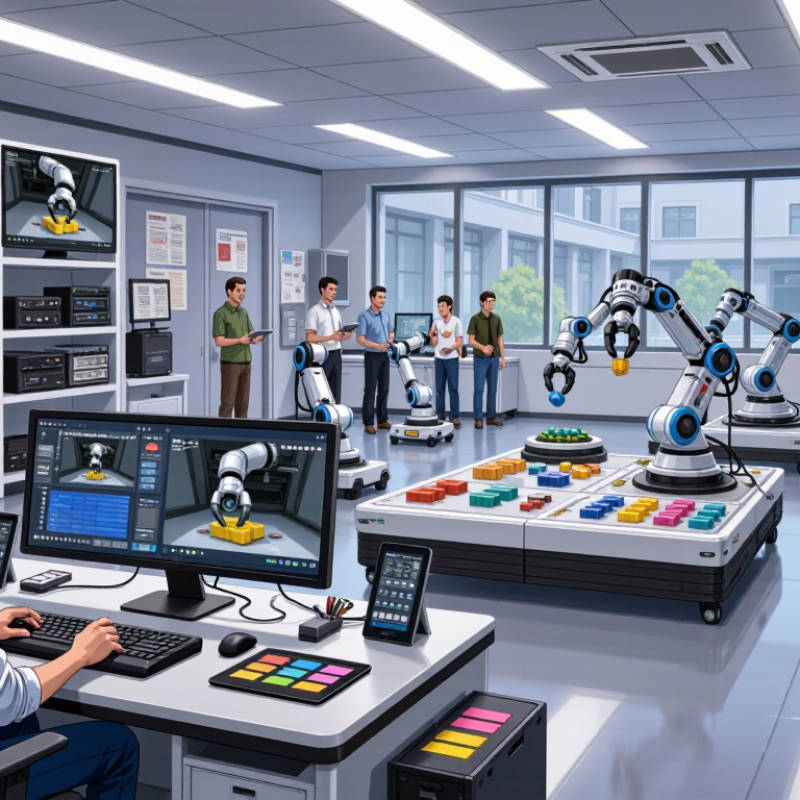
Robot teleoperation data collection means a human guides a robot through tasks while software records what the robot sees and does. A session may capture camera frames, joint positions, gripper commands, force readings, and task outcomes on a shared timeline. For example, an operator can guide a two-finger gripper to lift a ceramic cup, pause when it slips, and try again with a gentler approach. Those retries matter. They show more than a polished success clip.
The International Federation of Robotics reported 4,281,585 industrial robots operating worldwide in 2023 in World Robotics 2024. That figure describes robot deployment, not teleoperation datasets; the distinction matters. Collection teams still need to check timestamp alignment, camera views, operator consistency, and whether a task can be repeated safely. Latency can turn a delicate insertion into a collision. Some sessions remain messy. A dropped object or awkward recovery may reveal gaps that clean demonstrations hide. Teams should document robot configuration, task instructions, and recording conditions, then review samples before scaling collection. Raw volume alone is a weak measure of useful data.
Robot teleoperation data begins with a human guiding a machine through a task, often using a handheld controller or a camera-based interface. Providers record synchronized video, joint positions, gripper commands, and timestamps. A small delay can change how a reach looks. Small details matter.
The International Federation of Robotics’ World Robotics 2024 report counted 4,281,585 industrial robots operating worldwide in 2023. That figure does not measure teleoperation datasets, but it shows the scale of systems that may need reliable training and evaluation. During capture, teams should log camera views, robot state, task instructions, and interruptions, so later reviewers can reconstruct what happened.
Annotation turns raw recordings into usable examples. Trained reviewers mark task starts and finishes, object contact, grasp success, recovery attempts, and failure causes. They may also flag unclear footage instead of guessing. A clean label can still hide a bad motion. For example, a grasp may succeed while the object slips seconds later. Quality checks should compare labels with the recorded motion and preserve unsuccessful attempts, not only polished demonstrations. Provider teams can review disagreements between annotators and document revisions. Yet human judgments still vary; even careful guidelines cannot remove every ambiguity.
Evaluating a teleoperation data collection provider means looking beyond a smooth robot demonstration. Check whether its operators can handle varied objects, lighting, and awkward starting positions. Ask how many task attempts succeed, how failures are labeled, and whether raw video and robot-state records stay synchronized. Small timing errors matter.
The International Federation of Robotics reported 541,302 industrial robot installations worldwide in 2023, in World Robotics 2024. That scale makes reusable, reliable training data important. Providers should explain their sampling methods, quality checks, and repeatability across operators and hardware. Request a sample dataset and inspect timestamps, missing fields, camera views, and labels. A tidy dashboard proves little.
Operational details matter too. Measure control latency during real tasks, not just in a quiet demo room. Ask how operators are trained and how safety pauses are recorded. Confirm data access, retention, and permitted use in clear written terms. No scorecard is perfect. A provider may excel at throughput yet capture too few recovery attempts. That trade-off deserves scrutiny. Test with a representative task, including dropped objects or failed grasps, before committing to a large collection.
Robot teleoperation data providers differ in their operators, equipment, and quality checks. These seven profiles describe common service models, not endorsements. A full-stack provider supplies robot rigs, trained operators, and labeled recordings. It can simplify setup, though teams should inspect sample data before committing. A remote-operator network offers flexible staffing for longer collection sessions. Consistent control skills may vary. A hardware-integrated provider pairs teleoperation tools with specific robot platforms, which can reduce setup friction but limit equipment choice. A simulation-focused provider blends virtual tasks with real-world demonstrations. Check how closely its simulated scenes match your target workspace.
A manipulation specialist collects precise actions, such as grasping a small cup beside a cluttered tray. A data-quality provider reviews timestamps, camera views, and action labels, helping catch drift or missing frames. A regional deployment provider brings operators and equipment to local facilities, useful when lighting, surfaces, or layouts matter. Ask each provider for task-level coverage, operator training details, and examples of rejected recordings. Small gaps can matter. I would not assume that a large dataset is automatically useful; I have seen quantity distract from repeatability.
Tips: Request a short pilot using your robot and real task objects. Review several raw sessions, including failed attempts. Confirm how corrections are documented, and revisit the criteria after the first batch.
Choosing a robot teleoperation data collection provider starts with the task, not the demo. Define the robot, environment, and behavior you need to teach. A warehouse picking task, for example, may require varied box sizes, reflective wrapping, and partly blocked views. Ask how operators handle these conditions and how each session is recorded. Clean labels matter. Confirm that logs include timestamps, camera views, control inputs, task outcomes, and notes on failures. Without consistent records, a large dataset can still be hard to use.
Check operator training, equipment maintenance, and procedures for pausing a session when a robot behaves unexpectedly. Then run a small pilot using your own task. Measure usable demonstrations per hour, annotation agreement, repeated-task consistency, and the time needed to review files. A polished demo is not proof. Inspect raw samples, not just summary charts. Ask what happens when a camera shifts or a command is missed. Providers may report different metrics, so define terms together before comparing bids. A scorecard helps, but it will miss some real-world friction; leave room to revise the workflow after the first review.