
For over 50 years, we have dedicated ourselves to providing Industry with best in class wire management solutions and to helping solve mission critical issues.

The needs of today’s schools and universities are changing fast. When it comes to anticipating and meeting those needs, MonoSystems is in a class of its own.

For the past five decades, we’ve made it our business to offer more value to our partners, which in turn provides greater value to their customers.
Choosing Track Light Fixtures is not just a style decision. It affects how clearly a kitchen counter reads, whether artwork feels balanced, and how easily a room can adapt. A narrow beam can bring out texture in a framed print. The same beam may create harsh glare on a glossy countertop. Small details matter.
The U.S. Department of Energy’s Energy Saver guidance says LED bulbs use at least 75% less energy and last up to 25 times longer than incandescent bulbs. Those figures describe LED bulbs generally, not every track fixture. Still, they make efficiency and light-source compatibility worthwhile checks when comparing products. Look closely at beam angle, color temperature, dimming compatibility, track type, and replacement options. A fixture’s advertised brightness alone does not tell you how it will feel in your room.
Lighting designer Richard Kelly used the term “focal glow” for concentrated light that draws attention to a specific area. That idea helps explain why adjustable heads can be useful: they let you direct light toward a desk, display, or work surface. Yet adjustability is not a cure-all. Poor placement can leave dark patches or send light straight into someone’s eyes. This guide will compare fixture styles, explain key specifications, and show how to plan track lighting for different rooms. Expect practical trade-offs, not a perfect formula; even careful plans sometimes need a small adjustment after installation.
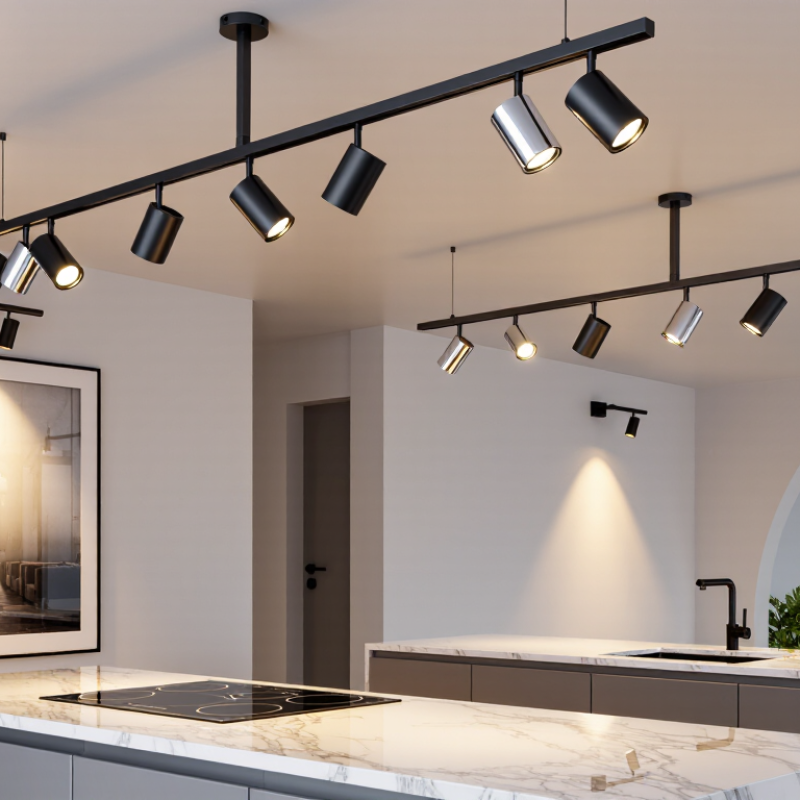
Track lighting is an electrical system, not simply a row of movable lamps. The track, or rail, carries power through internal conductors and supports each fixture. A power feed connects the rail to the building circuit. End caps, connectors, and corner pieces finish the layout. Small details matter. Track heads attach through adapters, and systems are not always interchangeable. Check the track type and voltage before buying replacement parts.
The fixture head shapes the light. A narrow beam can highlight a framed print, while a wider beam spreads light across a countertop. Look for compatible dimming controls and suitable ratings for the room. In my experience, adjustable heads are useful, but they can create glare if aimed carelessly. Fit comes first. For new wiring or uncertain connections, ask a qualified electrician to verify the setup.
Tips: Sketch the rail route before shopping. Measure the ceiling, mark feed and connector positions, and note where the light should land. Test one head’s position before installing the full run. It is easy to assume a layout will look balanced, then notice a dark corner later.
Start with the room’s actual use, not its square footage alone. A narrow kitchen needs light along counters, while a living room benefits from softer pools beside seating and shelves. Mark doors, windows, work surfaces, and tall furniture on a simple plan. That changes everything.
Use adjustable track heads to direct light across surfaces instead of straight down. Check each head’s beam angle: narrow beams can create bright spots, while wider beams help soften dark gaps. The Illuminating Engineering Society’s lighting guidance treats illuminance as task-dependent; a countertop and a hallway do not need the same light level. The U.S. Department of Energy reports that residential LEDs use at least 75% less energy and last up to 25 times longer than incandescent bulbs. That matters when several heads run for hours.
Avoid aiming lights directly at glossy counters, television screens, or seated eye level; glare is easy to miss on a drawing. Fixture count alone is a poor measure of coverage. Test the layout after dark, with furniture in place, and pivot heads until work surfaces look even. My paper plan is often imperfect. A floor lamp can still reveal a shadow the sketch missed.
Track compatibility comes before appearance. Common H, J, and L systems use different electrical contacts, so their heads are not interchangeable. Check the track label or installation documents before buying. Low-voltage magnetic tracks need a matching power supply and compatible fixtures. A mismatch can leave a room with attractive heads that simply do not work.
Fixture shape should follow the task. Adjustable spot heads suit a reading chair or artwork; wall-wash fixtures spread light across a textured wall. Pendant heads can bring light closer to a kitchen island. For beam angles, narrow beams around 15 degrees create crisp accents, while 30- to 40-degree beams cover broader surfaces. These ranges vary by fixture, so test the beam on the actual wall or tabletop. Check compatibility. Aim carefully.
LED heads are common for good reason: the U.S. Department of Energy’s Energy Saver guidance says LEDs use at least 75% less energy and last up to 25 times longer than incandescent lighting. Still, efficiency alone does not guarantee comfortable light. A narrow beam can make a painting vivid but leave nearby corners dim. That unevenness is easy to overlook on a showroom floor. Compare beam spread, color temperature, dimming compatibility, and track type together before choosing.
Beam angles are approximate and vary by fixture and manufacturer. Narrow beams create focused accent lighting, while wider beams spread light over larger areas. Choose a track head and beam angle to suit the object, room, and desired effect.
A sleek fixture is no good if its adapter does not match the track. Track systems may use different connector styles, voltages, and circuit layouts, so check the track type before buying. Confirm the fixture’s voltage, maximum load, dimmer compatibility, and beam angle. A narrow beam can highlight a framed print; a wider beam spreads light across a kitchen counter. Labels help, but they can still leave questions. Verify the exact system in the installation instructions.
Safe installation matters. The National Fire Protection Association’s Home Electrical Fires report estimates that electrical failures or malfunctions caused an average of 32,620 home structure fires annually from 2015 to 2019. Turn off power at the breaker and verify it is off before handling wiring. Check that the ceiling support is secure and the components are properly rated. If wiring, grounding, or circuit capacity is uncertain, ask a qualified electrician. A small mismatch can be easy to overlook.
Tips: Measure the track and note its connector type before shopping. Test the layout with the power off, then aim each head away from reflective screens and bare eyes. Check dimmer specifications, too; compatible-looking parts do not always work smoothly together. Keep the instructions nearby. It is worth checking twice.
When comparing track light fixtures, check watts, delivered lumens, beam angle, and dimmer compatibility. A low-wattage head may still disappoint if it leaves a worktop dim. The U.S. Department of Energy reports that LEDs use at least 75% less energy than incandescent lighting. That comparison is useful, but compare actual output and operating hours before estimating savings. Small details matter.
Controls can reduce waste when they suit the room. In a Lawrence Berkeley National Laboratory meta-analysis, occupancy sensors saved an average of 24% of lighting energy, while daylight-responsive controls averaged 28%. Those figures describe studied commercial settings, not a guaranteed result for every home or shop. A sensor aimed at a doorway may switch off lights while someone works quietly at a bench. Test the placement. Adjust the timeout.
Long-term value also depends on maintenance. Check whether track heads, drivers, and adapters can be replaced separately; a failed component should not force a full system change. Compare the fixture’s rated life and warranty, then consider access costs in high ceilings. A simple payback estimate can help: include purchase price, annual energy use, and likely replacement labor. Estimates are imperfect. Real use varies, and control settings often need readjustment after installation.
Comparison uses four light heads operating 3 hours per day for 365 days and an electricity rate of $0.16 per kWh. Annual energy cost is an estimate; actual results depend on usage, local electricity rates, product specifications, and control settings.
| Fixture Type | Example System Load | Estimated Annual Energy Use | Estimated Annual Energy Cost | Typical Rated Life | Controls and Practical Considerations | Long-Term Value |
|---|---|---|---|---|---|---|
| Integrated LED track heads | 4 × 10 W = 40 W | 43.8 kWh | $7.01 | Typically 25,000–50,000 hours, depending on product and operating conditions | Look for compatible dimming and a suitable color temperature. The LED light source is built into the head, so servicing may require replacing the head or fixture. | Low energy use and long rated life can reduce energy and relamping needs. Check warranty terms and whether replacement heads are available. |
| Track heads using replaceable LED lamps | 4 × 8 W = 32 W | 35.0 kWh | $5.61 | Often 15,000–25,000 hours for compatible LED lamps; verify the lamp rating | Confirm lamp base, beam angle, dimmer compatibility, and maximum fixture wattage. Replaceable lamps make maintenance straightforward. | Very low estimated energy use, with the added flexibility of replacing lamps separately from the track head. |
| Higher-output LED track heads | 4 × 15 W = 60 W | 65.7 kWh | $10.51 | Typically 25,000–50,000 hours for LED products | Useful when more light is needed for a larger area or brighter accent lighting. Choose beam angle and aiming carefully to limit glare. | Uses more energy than lower-wattage LED options, but may meet lighting needs with fewer heads. Compare delivered lumens, not watts alone. |
| Halogen track heads | 4 × 50 W = 200 W | 219.0 kWh | $35.04 | Often about 2,000–4,000 hours, depending on lamp type and use | Some systems support dimming, but dimming does not make halogen as energy-efficient as LED. Halogen lamps also produce more heat. | Typically higher energy use and more frequent lamp replacement than LED options. Check whether LED retrofit lamps are compatible with the existing heads and dimmer. |
| Dimmable LED with occupancy or daylight control | 4 × 10 W = 40 W at full output | About 35.0 kWh at an illustrative 20% reduction in operating energy | About $5.61 under the same illustrative scenario | Typically 25,000–50,000 hours; frequent switching and operating conditions can affect actual life | Requires compatible controls. The 20% reduction is an example, not a guaranteed saving; results depend on room use, daylight, dimming levels, and control settings. | Can improve value where lights are often left on unnecessarily or where daylight is available. Include control and installation costs when comparing options. |
Calculation: annual kWh = system watts ÷ 1,000 × 3 hours per day × 365 days. Annual cost = annual kWh × $0.16. Rated life and compatibility vary by product; check the fixture and lamp specifications before purchase.