
For over 50 years, we have dedicated ourselves to providing Industry with best in class wire management solutions and to helping solve mission critical issues.

The needs of today’s schools and universities are changing fast. When it comes to anticipating and meeting those needs, MonoSystems is in a class of its own.

For the past five decades, we’ve made it our business to offer more value to our partners, which in turn provides greater value to their customers.
Choosing the right Stainless Steel Pipe starts with understanding what it must carry and where it will operate. A pipe exposed to salt spray, cleaning chemicals, or outdoor moisture faces different demands from one used indoors. Temperature, pressure, flow rate, and connection method also affect the choice. Small details matter.
The stainless steel grade is important, but it is not the only decision. Grades such as 304 and 316 differ in corrosion resistance, while pipe dimensions and wall thickness influence strength and capacity. A polished surface may suit visible installations, yet finish alone cannot guarantee long service life. Conditions inside the pipe matter too.
Before comparing suppliers, gather the operating temperature, working pressure, fluid composition, required diameter, and installation environment. Confirm material specifications and test documentation with the manufacturer, especially for demanding service. If the application is unfamiliar, ask a qualified engineer to review the selection rather than relying on a product description. That step can prevent costly mismatches.
There is rarely one perfect option. A higher grade may add expense without meaningful benefit, while an economical choice may struggle in a corrosive setting. The trade-off is not always obvious from a product page. This guide explains the practical factors behind pipe selection, helping readers compare options with clearer expectations and ask more precise questions before ordering.
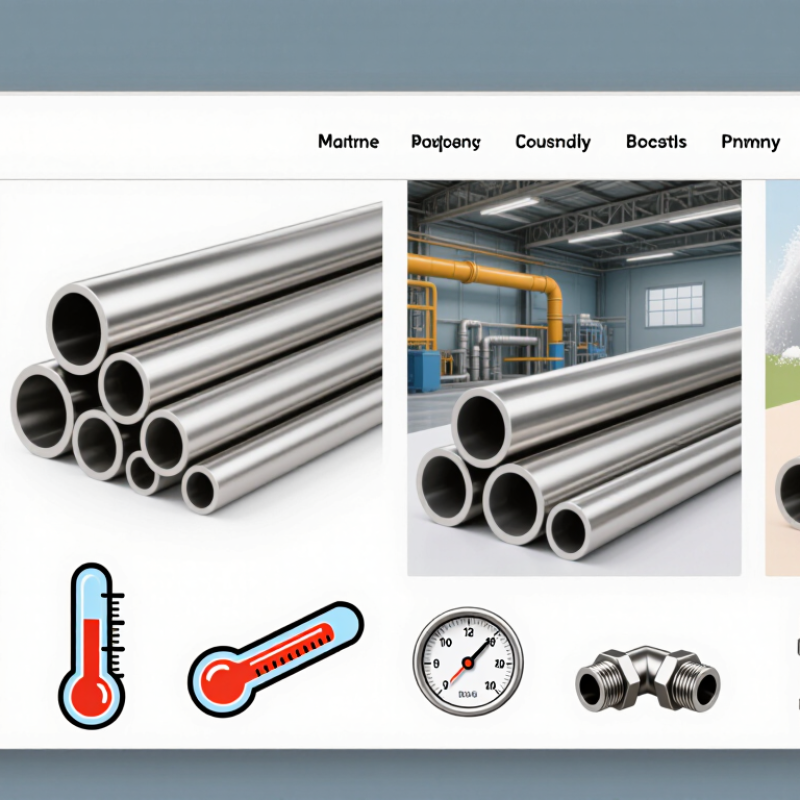
Choose a stainless steel pipe by defining its job before selecting a grade. What will flow through it: clean water, hot steam, or a chloride-bearing process fluid? Record the fluid’s chemistry, normal and peak temperatures, pressure, flow rate, and cleaning chemicals. Also consider outdoor exposure, vibration, and temperature cycling. A pipe that handles a mild fluid may still pit near a salty washdown area. Small details matter.
Temperature changes can move a pipe more than expected. Euro Inox’s Stainless Steel: Tables of Technical Properties reports a thermal expansion coefficient of about 16 × 10⁻⁶ per °C for grade 1.4301 between 20°C and 100°C. A six-metre run heated by 80°C may therefore expand roughly 7.7 millimetres. Allow for movement in supports and connections. Pressure capacity also depends on diameter, wall thickness, temperature, and joint design; check the applicable piping design requirements, not just the material grade. I’d still verify the actual fluid composition—“water” is not a complete specification.
Tips: Write down the worst operating conditions, not only typical ones. Then confirm grade, wall thickness, and corrosion suitability with a qualified materials or piping engineer.
Choose the grade from the actual service environment, not the pipe’s appearance. Record chloride levels, operating temperature, pH, cleaning chemicals, and whether liquid can stagnate. A pipe near a washdown hose may face warm, chloride-bearing droplets; a dry indoor line may not. Small details matter.
For mild indoor service, 304 stainless steel may be suitable. Grade 316 contains molybdenum, which improves resistance to chloride pitting, but it is not automatically suitable for seawater or every chemical process. For harsher chloride exposure, compare duplex grades and verify welding requirements. The NACE IMPACT study estimated global corrosion costs at US$2.5 trillion, or 3.4% of global GDP. It also estimated that improved corrosion management could save 15–35% of those costs. These figures show the stakes, not the service life of any specific pipe.
Ask for water or process-fluid analysis, including seasonal changes. Check welds, joints, flow conditions, and deposits, since sheltered crevices can corrode faster than exposed surfaces. ASTM G48 testing can compare pitting resistance under controlled conditions, but it cannot guarantee field performance. A practical choice may still involve uncertainty; document assumptions and test a representative sample when failure would be costly.
How to Choose the Right Stainless Steel Pipe?
Determine the Required Diameter, Wall Thickness, and Length
Start with the flow requirement and connection type. Stainless steel pipe is often specified by nominal size, which may not equal its measured outside diameter. Check the relevant sizing standard and confirm whether fittings, valves, or existing pipework must match. For example, measure a sample pipe with calipers rather than relying on a rough visual estimate. A few millimeters can matter. Consider the fluid’s flow rate, temperature, and viscosity; an undersized bore may restrict flow, while an unnecessarily large one can add cost and weight.
Choose wall thickness based on operating pressure, temperature, and the installation environment. Thicker walls can provide more pressure capacity, but they also reduce the internal diameter and increase weight. Check the pipe’s material grade and published pressure ratings, then have a qualified engineer verify demanding or safety-critical applications. Corrosive fluids and outdoor exposure also deserve attention. I have seen specifications overlook these details; the chosen thickness may look fine on paper but still be unsuitable for service.
Tips: Confirm whether the listed diameter is nominal or actual. Measure the route, then allow for bends, fittings, and trimming. Keep a little extra length. Too much can complicate handling, though, so recheck the drawing before ordering. Length estimates are easy to get wrong when site measurements are rushed.
| Nominal Pipe Size (NPS) | Outside Diameter (mm) | Schedule 40S Wall Thickness (mm) | Approximate Inside Diameter (mm) | Typical Stock Lengths | Selection Guidance |
|---|---|---|---|---|---|
| 1/2 in | 21.3 | 2.11 | 17.1 | 6 m or 12 m; confirm availability | Suitable for compact lines; check that the bore meets the required flow and pressure-drop limits. |
| 1 in | 33.4 | 3.38 | 26.6 | 6 m or 12 m; confirm availability | Compare the inside diameter with the flow requirement and the dimensions of connected fittings. |
| 2 in | 60.3 | 3.91 | 52.5 | 6 m or 12 m; confirm availability | A larger bore can support greater flow at a given fluid velocity, but verify system pressure loss. |
| 3 in | 88.9 | 5.49 | 77.9 | 6 m or 12 m; confirm availability | Check the available space, support spacing, connection type, and required design conditions. |
| 4 in | 114.3 | 6.02 | 102.3 | 6 m or 12 m; confirm availability | Confirm that the selected wall thickness is suitable for the design pressure, temperature, and service. |
| 6 in | 168.3 | 7.11 | 154.1 | 6 m or 12 m; confirm availability | Plan lifting, transport, and supports as well as the route and connection dimensions. |
How to use this table: Select the nominal size using the required flow, allowable pressure drop, and matching components. Schedule 40S dimensions are standardized nominal dimensions; the approximate inside diameter is calculated as outside diameter minus twice the wall thickness. Choose a wall thickness only after checking the applicable design code, pressure, temperature, corrosion allowance, and material grade. Specify the required finished length, cutting tolerance, and any allowance for joining or end preparation when ordering.
Dimension values shown are standard Schedule 40S pipe dimensions in accordance with ASME B36.19M. Stock lengths vary by supplier and product; verify availability and tolerances before purchase.
How to Choose the Right Stainless Steel Pipe?
Choose the pipe type by considering the fluid, temperature, pressure, and environment. Grade affects corrosion resistance, while pipe dimensions and wall thickness affect fit and strength. A pipe exposed to salty spray may need different corrosion resistance from one carrying clean water indoors. Check the project specification, not just the material label. Details matter.
Manufacturing method is another practical choice. Seamless pipe has no longitudinal weld seam and may suit demanding pressure conditions, but it can cost more. Welded pipe is made by forming and joining stainless steel, and often offers an economical option for common service. Neither method is automatically better. Confirm the required dimensions, inspection criteria, and applicable service conditions with a qualified engineer; a generic recommendation can miss a critical detail.
Match the connection to the system and the work site. Welding can create a compact, permanent joint, but requires suitable procedures and careful control of heat and cleanliness. Threaded connections are easier to assemble or replace, though they may not suit every pressure or temperature. Flanges allow convenient maintenance, while grooved joints can speed installation where the system is designed for them. Measure the mating parts before ordering. Even a small mismatch can delay installation, and that is easy to overlook.
Start with the service conditions: fluid, temperature, pressure, and corrosion exposure. Then confirm the governing specification with the project engineer. ASTM A312 covers common austenitic stainless steel pipe; ASTM A790 covers duplex grades. Dimensions may be specified under ASME B36.19M. Requirements vary by application and region, so a familiar standard is not automatically the right one. The World Stainless Association reported 58.4 million tonnes of global stainless crude steel production in 2023. With many grades and product routes in circulation, clear material identification matters.
Request a material test report linked to the pipe’s heat number. Check that the grade, chemistry, dimensions, and mechanical results match the purchase specification. Where required, confirm the inspection certificate type, such as EN 10204 3.1, and verify the issuing process. A certificate is useful, but it is not a guarantee. Compare markings on the pipe with the documents, and review applicable hydrostatic, non-destructive, or positive material identification test records. Look for dents, rough welds, scale, and inconsistent wall thickness. Small discrepancies deserve a question.
Tips: Photograph the heat number before cutting. Keep certificates with the receiving record. If a value looks odd, pause and ask the supplier or inspector to clarify it. Paperwork can be tidy while the pipe tells another story.