For over 50 years, we have dedicated ourselves to providing Industry with best in class wire management solutions and to helping solve mission critical issues.

The needs of today’s schools and universities are changing fast. When it comes to anticipating and meeting those needs, MonoSystems is in a class of its own.
For the past five decades, we’ve made it our business to offer more value to our partners, which in turn provides greater value to their customers.
What Is a Pneumatic Conveying Blower Used For?
A Pneumatic Conveying Blower supplies the airflow that carries bulk materials through enclosed pipes. Depending on the system design, it pushes air under pressure or draws material using vacuum. In a typical dilute-phase setup, air suspends particles such as flour, plastic pellets, or grain and moves them toward a receiving point. The material travels inside the pipe, not through the blower itself. Small details matter.
Conveying systems are used in manufacturing, food processing, agriculture, and other facilities that handle dry bulk solids. Blowers may be paired with hoppers, feeders, filters, and separators. Their performance depends on factors such as pipe length, bends, material density, particle size, and the required conveying rate. The right choice can support steady flow and help limit spills and dust. A blower that is poorly matched to the system may consume excess energy or fail to move material reliably. Not always simple.
This guide explains what a Pneumatic Conveying Blower does, how it fits into a conveying system, and which operating factors affect its performance. It also considers common blower types and practical selection questions. Operators should compare system requirements with manufacturer data, including airflow, pressure, temperature limits, and duty cycle. A realistic selection involves more than matching a motor rating to a number on a specification sheet. Airflow is only part.
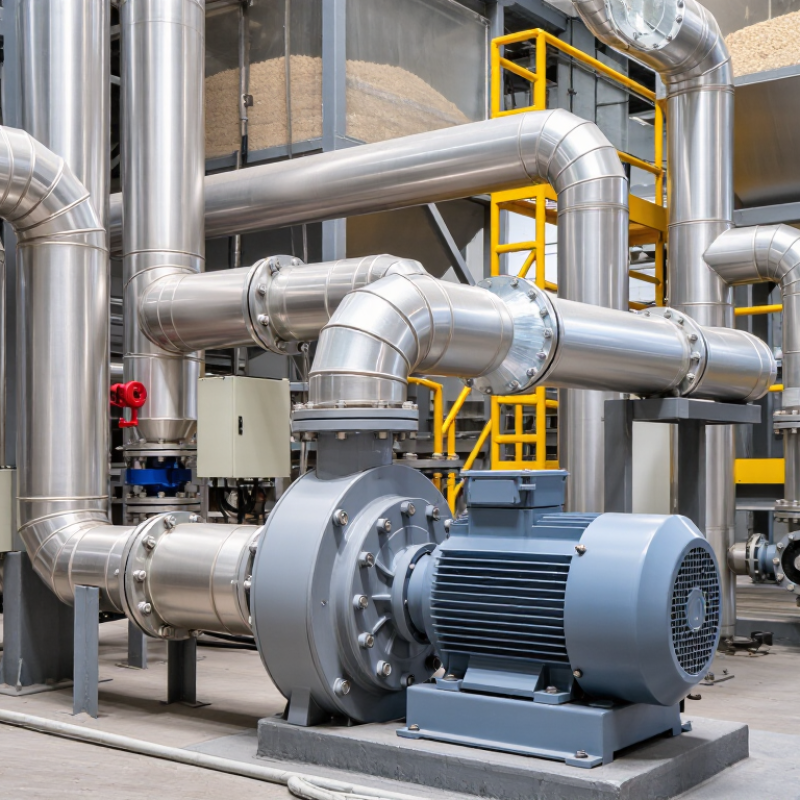
What a Pneumatic Conveying Blower Is
What a Pneumatic Conveying Blower Is
A pneumatic conveying blower is a machine that moves air to carry dry bulk materials through a pipeline. It creates the airflow that keeps particles moving from a feed point to a destination. The blower does not push the solids directly. Air does the work.
In a pressure system, the blower sends air into the conveying line and pushes material forward. In a vacuum system, it draws air through the line, pulling material toward a receiver. Typical components include a feeder, pipes, filters, and a collection vessel. Their design affects how smoothly the system runs. Powder, grain, and plastic pellets behave differently, so blower capacity and airflow must suit the material and route. A simple estimate can miss real-world effects, such as bends, leaks, or damp material.
Tips: Check the material’s particle size, moisture, and fragility before choosing a blower. Note the pipe length and number of bends. Watch for dust at connections and unusual changes in noise or pressure. These details can reveal problems early. No single setting suits every installation; initial calculations may need adjustment after testing.
| Aspect | Description | Typical Examples or Considerations |
|---|---|---|
| What it is | A machine that supplies a flow of air or another conveying gas to move bulk materials through a pipeline. | Depending on the system, the blower may provide positive pressure to push material or vacuum to draw it. |
| Primary purpose | To provide the airflow and pressure difference needed to transport dry, bulk solids between process points. | It can move material from a pickup point to a storage bin, mixer, packaging line, or processing machine. |
| Common materials conveyed | Dry powders, granules, pellets, and other suitable free-flowing bulk solids. | Examples include flour, cement, plastic pellets, grain, and powdered minerals. Material properties affect system design. |
| Dilute-phase conveying | Air carries particles at relatively high velocity, with the solids dispersed through the conveying line. | Often used for powders and granules that can be conveyed in suspension. Air velocity must be sufficient to keep material moving. |
| Dense-phase conveying | Moves material at a higher solids concentration and generally lower velocity than dilute-phase conveying. | System arrangements vary; dense-phase systems may require pressure vessels and higher conveying pressures than a blower alone typically supplies. |
| Positive-pressure systems | The blower supplies air upstream, pushing material through the pipeline toward its destination. | Useful for conveying from one feed point to one or more receiving points, subject to the system layout and material requirements. |
| Vacuum systems | A vacuum source creates suction that draws material and air toward a receiver. | Often selected for pickup from multiple points or where containing dust within the conveying equipment is important. |
| Airflow and pressure | The blower must deliver airflow and pressure appropriate to the material, pipeline, distance, and conveying method. | There is no single suitable operating point for every system; pressure losses increase with factors such as line length, bends, and material loading. |
| Blower selection | Selection depends on required airflow, pressure or vacuum, operating conditions, and the properties of the conveyed material. | Engineers also consider temperature, altitude, filtration, noise limits, duty cycle, and whether the gas must be oil-free. |
| Supporting equipment | A blower operates as part of a conveying system rather than as a material-handling device by itself. | Typical components include feed devices, pipelines, bends, filters, airlocks, receivers, and controls. |
| Key operating considerations | Correct airflow helps prevent line blockage, excessive particle wear, and unnecessary energy use. | Filters need suitable dust collection and maintenance; combustible dust may require a properly engineered safety system. |