What Is SCH80 Heavy Wall Seamless Pipe?
SCH80 heavy wall seamless pipe is often misunderstood as a steel grade. It is not. “Schedule 80” identifies a thicker wall dimension, while the material grade depends on standards such as ASTM A106, ASTM A53, or API 5L. ASME B36.10M provides the dimensional framework. The actual wall thickness still changes with nominal pipe size.
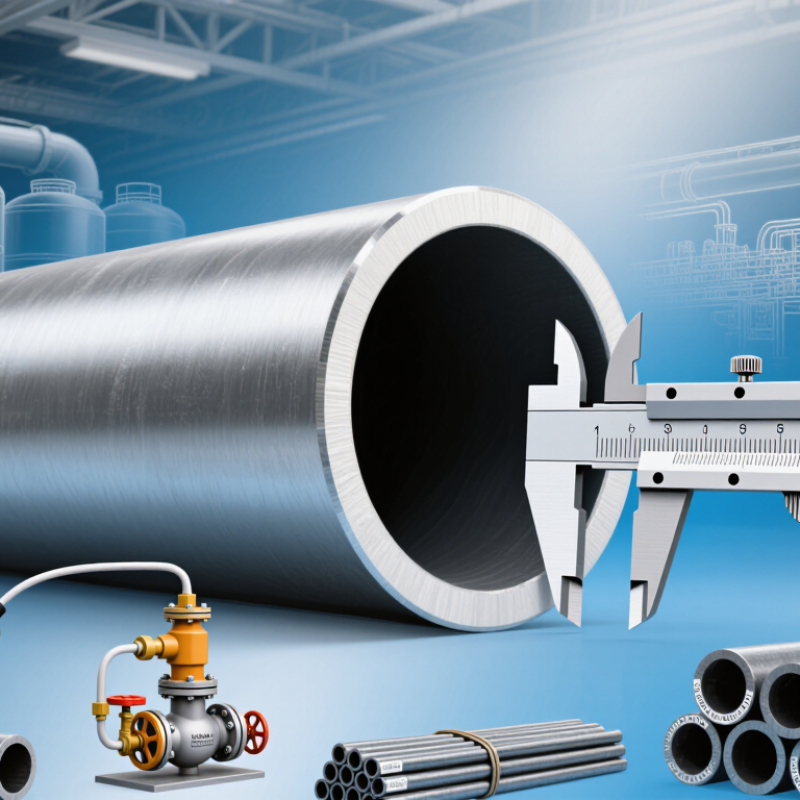
The need for reliable heavy wall pipe remains visible across energy, chemical processing, and industrial construction. The World Steel Association’s Short Range Outlook reflects continued demand from infrastructure and energy projects. However, market demand does not guarantee product quality. A Heavy wall seamless pipe SCH80 factory must control billet chemistry, piercing, rolling, heat treatment, and final inspection. A digital caliper checks wall thickness. Ultrasonic testing can reveal internal discontinuities. Hydrostatic testing verifies pressure resistance. Mill certificates must match the heat number stamped on each bundle.
W. Edwards Deming, a leading quality-management expert, wrote, “Quality comes not from inspection, but from the improvement of the production process.” That principle remains practical inside a modern pipe mill. Inspection catches problems, but disciplined process control prevents many of them. Even so, no factory should treat SCH80 as automatically superior. The wrong grade, tolerance, or connection can still cause failure. Buyers should review ASTM compliance, ASME dimensions, test records, traceability, and corrosion protection before approval. A strong introduction must admit this limitation: pipe selection depends on pressure, temperature, fluid, welding, and service conditions.
Definition and Meaning of SCH80 Heavy Wall Seamless Pipe
SCH80 heavy wall seamless pipe is steel pipe made without a welded seam and specified with a Schedule 80 wall thickness. “SCH80” describes a dimensional series, not a single fixed wall measurement. The actual thickness changes with the pipe’s nominal size. For example, a small-diameter pipe and a large-diameter pipe can both be Schedule 80, yet have different wall thicknesses.
“Heavy wall” is a practical description, not a separate universal dimension. Compared with Schedule 40 pipe of the same nominal size, Schedule 80 usually has a thicker wall and a smaller internal opening. That extra metal can support higher pressure in some applications, but Schedule alone does not establish a safe working pressure. Material grade, temperature, fluid, and design conditions also matter. Details count.
“Seamless” means the pipe body is formed without a longitudinal welded joint. This can be useful where consistent construction is required, though seamless pipe is not automatically better for every installation. Check the specified outside diameter, wall thickness, material grade, and applicable manufacturing standard before selection. A small mismatch may affect fit, flow, or connection work. In practice, “heavy wall” can be used loosely, so drawings and inspection records should state the actual dimensions.
SCH80 Dimensions, Wall Thickness, and Pressure Ratings
SCH80 describes a heavier wall than SCH40 for the same nominal pipe size. The outside diameter stays fixed, while the inside diameter becomes smaller. For NPS 2 pipe, the outside diameter is 2.375 inches and the SCH80 wall is 0.218 inch thick. That leaves an approximate inside diameter of 1.939 inches. For NPS 4, the wall is 0.337 inch. Small details matter.
These dimensions follow standard pipe tables, but pressure ratings do not come from the schedule number alone. They depend on material grade, operating temperature, manufacturing condition, and the design rules used for the system. A carbon-steel pipe and a stainless-steel pipe of identical size may not have the same allowable pressure. Temperature can reduce the allowable stress, too. A table without those conditions is incomplete.
SCH80’s thicker wall can provide more pressure capacity than a thinner schedule in comparable conditions, but it also reduces flow area and adds weight. For a real selection, confirm the nominal size, material specification, temperature, and design pressure with a qualified engineer or the applicable code. I would not rely on a generic online pressure chart; it may omit key assumptions. Even a correct dimension can be used incorrectly.
What Is SCH80 Heavy Wall Seamless Pipe? — SCH80 Dimensions, Wall Thickness, and Pressure Ratings | Nominal Pipe Size (NPS) | Outside Diameter (in) | Outside Diameter (mm) | SCH80 Wall Thickness (in) | SCH80 Wall Thickness (mm) | Approx. Inside Diameter (in) | Pressure-Rating Consideration |
| 1/2 | 0.840 | 21.3 | 0.147 | 3.73 | 0.546 | Not fixed by schedule alone |
| 3/4 | 1.050 | 26.7 | 0.154 | 3.91 | 0.742 | Not fixed by schedule alone |
| 1 | 1.315 | 33.4 | 0.179 | 4.55 | 0.957 | Not fixed by schedule alone |
| 1 1/4 | 1.660 | 42.2 | 0.191 | 4.85 | 1.278 | Not fixed by schedule alone |
| 1 1/2 | 1.900 | 48.3 | 0.200 | 5.08 | 1.500 | Not fixed by schedule alone |
| 2 | 2.375 | 60.3 | 0.218 | 5.54 | 1.939 | Not fixed by schedule alone |
| 2 1/2 | 2.875 | 73.0 | 0.276 | 7.01 | 2.323 | Not fixed by schedule alone |
| 3 | 3.500 | 88.9 | 0.300 | 7.62 | 2.900 | Not fixed by schedule alone |
| 4 | 4.500 | 114.3 | 0.337 | 8.56 | 3.826 | Not fixed by schedule alone |
| 6 | 6.625 | 168.3 | 0.432 | 10.97 | 5.761 | Not fixed by schedule alone |
| 8 | 8.625 | 219.1 | 0.500 | 12.70 | 7.625 | Not fixed by schedule alone |
| 10 | 10.750 | 273.1 | 0.500 | 12.70 | 9.750 | Not fixed by schedule alone |
| 12 | 12.750 | 323.9 | 0.500 | 12.70 | 11.750 | Not fixed by schedule alone |
| 14 | 14.000 | 355.6 | 0.500 | 12.70 | 13.000 | Not fixed by schedule alone |
| 16 | 16.000 | 406.4 | 0.500 | 12.70 | 15.000 | Not fixed by schedule alone |
| 18 | 18.000 | 457.2 | 0.500 | 12.70 | 17.000 | Not fixed by schedule alone |
| 20 | 20.000 | 508.0 | 0.500 | 12.70 | 19.000 | Not fixed by schedule alone |
| 24 | 24.000 | 609.6 | 0.500 | 12.70 | 23.000 | Not fixed by schedule alone |
| Pressure rating: SCH80 specifies nominal wall thickness; it does not assign one universal allowable working pressure. The permitted pressure must be calculated for the pipe material and grade, design temperature, applicable piping code, manufacturing tolerance, corrosion allowance, and service conditions. |
Notes: Dimensions shown are standard nominal dimensions for steel pipe in Schedule 80. Approximate inside diameter is calculated as outside diameter minus twice the nominal wall thickness; actual dimensions may vary within applicable manufacturing tolerances. “Seamless” describes the manufacturing method and does not change the Schedule 80 dimensional series.
Manufacturing Process and Common Materials
SCH80 heavy wall seamless pipe is made without a welded seam. Its wall thickness follows Schedule 80 requirements, but the exact thickness changes with nominal pipe size. This detail is often missed. A larger pipe may have a much thicker wall than a smaller pipe, even under the same schedule.
Manufacturing starts with a solid round steel billet. The billet is heated and pushed through rotary piercing rolls, creating a hollow shell. Mandrel rolling then reduces the wall and controls the outside diameter. Sizing mills improve dimensional accuracy. The pipe may receive heat treatment to adjust strength, toughness, and internal structure. Straightening, cutting, and surface cleaning follow. In the final stage, inspectors check wall thickness, ovality, length, and surface defects. Ultrasonic or hydrostatic testing may reveal flaws that visual inspection cannot find.
Carbon steel is a common choice for general pressure service and structural applications. Low-alloy steel can provide better strength at elevated temperatures. Stainless steel is selected when corrosion resistance matters, especially around moisture or aggressive process fluids. Material certificates should identify chemical composition, mechanical properties, heat numbers, and test results. In practice, paperwork may look complete while a measurement is still wrong. Checking several points around each pipe is wiser than trusting one reading. Storage also matters; wet ground and damaged end caps can promote corrosion before installation.
Key Properties and Industrial Applications
SCH80 heavy wall seamless pipe is manufactured without a welded seam, giving it a continuous pressure boundary. “Schedule 80” defines wall thickness, not a universal strength grade. For example, ASME B36.10M lists a 0.218-inch wall for NPS 2 and a 0.432-inch wall for NPS 6. These dimensions improve resistance to internal pressure, impact, and localized corrosion.
Its key advantage appears in demanding service. ASTM A106 covers seamless carbon steel pipe for high-temperature applications, including steam lines, refineries, and process plants. ASTM A333 adds grades for low-temperature service. Material selection still matters. A thick wall cannot correct poor toughness or unsuitable chemistry. It is an easy mistake to treat schedule as a complete design specification.
Industrial users often choose SCH80 pipe for boiler feedwater, compressed-gas systems, hydraulic circuits, and chemical transfer lines. The U.S. Energy Information Administration describes the country’s natural-gas network as extending over three million miles, showing the scale of piping infrastructure that requires controlled fabrication and inspection.
In practice, inspectors check outside diameter, wall thickness, straightness, heat numbers, and nondestructive test records. One detail is frequently underestimated: thicker pipe increases weight, welding time, and support loads. The decision should balance pressure, temperature, corrosion allowance, installation space, and lifecycle cost.
Selection, Inspection, and Installation Considerations
What Is SCH80 Heavy Wall Seamless Pipe?
SCH80 seamless pipe has a thicker wall than many standard pipe schedules, but “heavy wall” is not one universal thickness. The actual wall depends on the nominal pipe size. Its seamless construction removes a longitudinal weld, which can support demanding pressure and temperature service when the material and manufacturing controls are suitable. Selection should begin with design pressure, operating temperature, fluid chemistry, flow requirements, and allowable stress. Do not select by schedule alone.
Inspection needs both documents and physical checks. Confirm the material grade, heat number, dimensions, wall thickness, ovality, straightness, and end condition. Review the material certificate against the purchase specification and applicable standards. Ultrasonic thickness checks can reveal local thinning, while hydrostatic testing may verify pressure integrity when required. Inspectors should also examine pipe ends for dents, laminations, and damaged bevels. Small defects become expensive after installation.
During installation, keep the bore clean and protect caps until fit-up. Use correct supports to prevent sagging, especially with long, heavy sections. Avoid forcing misaligned joints into position. That mistake can create hidden stress. Welding requires qualified procedures, suitable filler materials, controlled preheating, and proper inspection. Threading may reduce wall strength and may be unsuitable for high-pressure service. Field conditions often differ from drawings, so the installer should recheck clearances, thermal movement, and support locations before final joining. No checklist is perfect. A second review can catch an overlooked mismatch.