Selection should begin with the actual load, not an estimated average. Check the manufacturer’s rating for evenly distributed weight, shelf span, and configuration. MHI’s 2024 Annual Industry Report identified labor shortages as a challenge for 55% of supply-chain respondents. Adjustable shelving can reduce reaching and searching, but poor layout still wastes labor. Measure item dimensions, access paths, ceiling height, and future inventory growth.
Vertical Markets Weekly Promo


Industrial
For over 50 years, we have dedicated ourselves to providing Industry with best in class wire management solutions and to helping solve mission critical issues.
School + University
The needs of today’s schools and universities are changing fast. When it comes to anticipating and meeting those needs, MonoSystems is in a class of its own.
Systems Integrators
For the past five decades, we’ve made it our business to offer more value to our partners, which in turn provides greater value to their customers.
What Is Steel Shelving and Why Is It Used?
Steel Shelving is a practical storage system made from formed or rolled steel components. It usually combines upright frames, horizontal beams, and adjustable shelves. Depending on its design, it may hold boxes, tools, spare parts, files, or retail stock. Its value is not simply strength. Steel resists daily knocks, supports organized access, and suits warehouses, workshops, offices, archives, and garages. A well-planned unit turns unused wall height into usable storage without demanding complex equipment.
In professional settings, selection begins with the actual load, not an attractive photograph. Users should check the rated capacity for each shelf, the total bay, shelf spacing, floor condition, and anchoring requirements. Manufacturer instructions matter because similar-looking products can perform very differently. Clean, dry steel may last for years, while moisture, chemicals, impact, and overloading can accelerate corrosion or distortion. Regular checks can reveal bent uprights, loose fasteners, damaged coatings, or shelves that sag visibly. Small warning signs should not be ignored.
Still, Steel Shelving is not a universal answer. It may be unsuitable where extreme humidity, strict hygiene controls, or unusually heavy loads demand specialized systems. That assumption is incomplete. The best choice balances capacity, access, budget, workplace safety, and future expansion. Experienced installers measure aisles and handling routes before assembly, then label shelves clearly after installation. Even a modest unit deserves careful review, because reliable storage depends on correct use as much as on strong material.
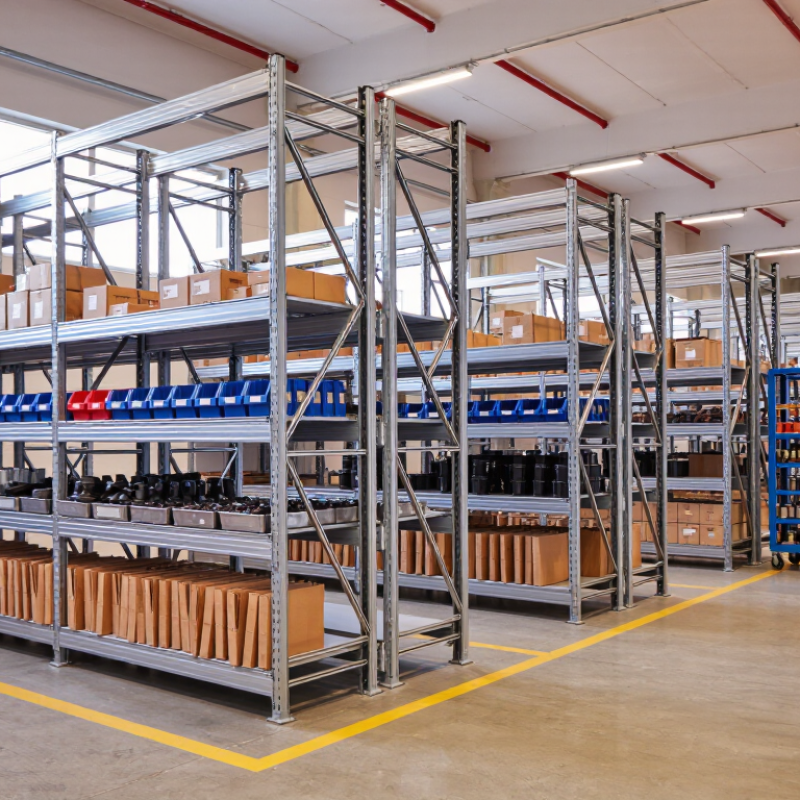
Table of Contents [Hide]
Definition and Core Structure of Steel Shelving
Steel shelving is a freestanding storage system made mainly from formed steel components. Its core structure usually includes upright posts, horizontal beams, shelf panels, braces, and adjustable connectors. The uprights carry vertical loads, while beams transfer weight across each shelf. Bracing limits sideways movement.
Load paths matter.
Shelf panels may use solid steel, wire mesh, or perforated sheets. Steel manufacturing also supports large-scale supply.
The World Steel Association reported approximately 1.89 billion tonnes of crude steel production worldwide in 2023, showing the material’s broad industrial availability. This supply supports consistent dimensions, replacement parts, and scalable storage construction.
In practical installation, workers should inspect floor level, frame alignment, fastener engagement, and rated capacity.
ANSI MH16.1-2023 provides design and safety guidance for industrial steel storage racks, although shelving systems still require application-specific review. A catalog rating is not universal. It can change with shelf spacing, load placement, impact, and anchoring conditions.
Steel shelving is used because it combines high strength with repeatable adjustment. A warehouse may hold cartons on solid panels, while a workshop may use mesh shelves for airflow and visibility.
EPA’s Sustainable Materials Management data also reports a 70.9% recycling rate for steel containers and packaging in 2018, supporting steel’s circular-material advantage, though shelving itself is not packaging.
The overlooked weakness is poor planning. Even strong steel can become unstable when heavy items sit near the front edge.